
July 2026


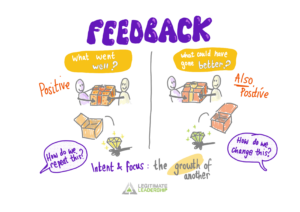
I don’t use the term positive and negative feedback anymore – when you get the intent right, all feedback is a gift.  If we want to help others achieve their best, we need to give feedback that helps them to reinforce what went well and improve where things could be better.  Surely, knowing about both of these areas is beneficial; as leaders, we should embrace every opportunity to provide such feedback.
Rachael Cowin, Associate, Legitimate Leadership.

________________________________________________________

Featured

Question Of The Month

How do I give feedback without demotivating my team?

When Coaching Alone Isn’t Enough: The Case for Systemic Change

I have been an executive coach since 2007. It is work I love deeply; there is something profoundly privileged about holding up a clear, unfiltered mirror for someone, creating the space for them to confront gaps in their own authenticity and leadership.

But over the past two decades, I have arrived at an uncomfortable truth: coaching, on its own, has limits.

When an organisation’s culture and systems are not conducive to a coaching or learning way of leading, even the most powerful individual breakthroughs can quietly unravel.

How To Give Feedback That Lands

In How to Give Feedback That Lands, Dr Renee St. Jacques challenges the common perception that feedback is something people naturally resist. Instead, she suggests that feedback becomes difficult when it feels personal, vague, or disconnected from growth. Effective feedback is not about judging someone’s character; it is about helping them understand the impact of their actions and supporting their development.


For more information regarding the above, please email events@legitimateleadership.com

Question Of The Month 

By Tony Flannigan, Associate, Legitimate Leadership.

Question: How do I give feedback without demotivating my team?

Answer:  Here’s the thing: the question itself contains a hidden assumption worth unpacking. Most people asking this are focused on the how of feedback. But whether feedback motivates or demotivates has far less to do with technique than most leaders think. It comes down to one word: intent.

Why are you giving this feedback? And, more importantly, does the person receiving it believe your answer to that question?

It Starts With Intent

Kim Scott, in her book Radical Candor, describes four kinds of feedback (a framework well worth exploring). But even the most skillfully delivered feedback will land badly if the person on the receiving end suspects it is coming from a place of judgement, frustration, or self-interest rather than genuine care for their development.

The Legitimate Leadership framework is clear on this: if your people believe you are giving feedback because you truly want them to be as good as they can be, that you are, in the deepest sense, for them, then feedback becomes a gift. If they don’t believe that, no amount of technique will save you.

So, before we talk about the ‘how’, get the why right.

The ‘How’ Still Matters

Once your intent is right, skill absolutely helps. Here is what works in practice:

  1. Give it promptly. The analogy with puppy training is apt; feedback three weeks after the event is largely useless. The closer to the observation, the better.
  2. Give it in manageable doses. Too much at once, and the key message gets lost. People switch off. Pick the one thing that matters most right now.
  3. Make it specific. “You were great in that meeting” tells someone nothing useful. Neither does “that didn’t go well.” What exactly happened? What was the impact? No data, no growth opportunity…

Read Tony Flannigan’s full response by clicking here.

To submit your question, email info@legitimateleadership.com 


Article: When Coaching Alone Isn’t Enough: The Case for Systemic Change

By Stefaan van den Heever,  Associate, Legitimate Leadership.

This article was originally written by Stefaan van den Heever in 2018. Nearly a decade later, his observation that coaching alone cannot drive lasting change feels more relevant than ever.

I have been an executive coach since 2007. It is work I love deeply; there is something profoundly privileged about holding up a clear, unfiltered mirror for someone, creating the space for them to confront gaps in their own authenticity and leadership.

But over the past two decades, I have arrived at an uncomfortable truth: coaching, on its own, has limits.

When an organisation’s culture and systems are not conducive to a coaching or learning way of leading, even the most powerful individual breakthroughs can quietly unravel.

The Collision
Here is what I have observed, time and again. During coaching, a leader gains genuine insight. They commit to new behaviours. They leave sessions energised and resolved. And then, something happens. Their new frame of reference collides with the reality of the organisation around them.

A mission statement hangs on a wall. Values are printed in an annual report. But the lived culture tells a different story entirely.

I was part of an intervention at a manufacturing plant some years ago. The goal was to develop a coaching leadership style, one built on listening, asking questions, and genuine engagement. The training landed well. People connected to it. There was real energy in the room.

But when the pressure came, as it always does, people reverted. Command and control reasserted itself almost instinctively.

“It’s hard to collaborate with another department when we’re competing against them for KPIs.”

That sentence captures the problem precisely. You cannot coach people into a new way of being if the system they return to every day is designed to pull them in the opposite direction.

Read the full article by clicking here


Video: How To Give Feedback That Lands

By Dr. Renee St. Jacques is a psychologist, executive coach, and TEDx speaker who helps leaders build trust, strengthen relationships, and create high-performing workplace cultures through emotionally intelligent leadership.

Comment on the video by Leonie van Tonder, Associate, Legitimate Leadership: Ken Blanchard famously said, “Feedback is the breakfast of champions.” I couldn’t agree more. Actionable, continuous input is the essential fuel that individuals and teams need to improve, grow, and reach peak performance consistently.

But here is what I have learned from working with leaders, knowing this is not enough. How we give feedback matters just as much as whether we give it at all.

  • Do not wait for annual performance reviews. Create structured, frequent opportunities for honest exchange.
  • When you receive or give input, treat it objectively. Focus on the benefit of the proposed change rather than experiencing criticism as a personal failure.
  • Keep your conversations separate, deal with “room for improvement” and “well done” in different discussions. Mixing the two dilutes both.
  • Remember that as humans, we tend to remember what suits us, not necessarily what we need to hear. This is why frequency and structure matter.
  • Do not put your solution on the table before the other person has had the opportunity to reflect and correct themselves. Give them that chance first.
  • Awareness is half the battle. But real change only happens when new behaviour stops being something we have to think about, when it becomes part of who we are, not just learned or expected conduct.

Finally, be courageous. Do not be unkind, but do not soften your message so much that it loses its meaning. The person does not have to like the feedback in the moment. The benefit will show itself later.

Our summary of this video: In How to Give Feedback That Lands, Dr Renee St. Jacques challenges the common perception that feedback is something people naturally resist. Instead, she suggests that feedback becomes difficult when it feels personal, vague, or disconnected from growth. Effective feedback is not about judging someone’s character; it is about helping them understand the impact of their actions and supporting their development.

The video emphasises the importance of focusing on observable behaviours, being specific about the impact those behaviours have, and approaching conversations with a genuine desire to help rather than to criticise. When feedback is delivered with clarity, respect, and positive intent, it is far more likely to be received, understood, and acted upon.

From a Legitimate Leadership perspective, this aligns strongly with the principle of Care & Growth. Legitimate leaders recognise that growth cannot occur without feedback, and that withholding feedback to avoid discomfort may actually limit another person’s development. At the same time, feedback that is delivered without care can damage trust and reduce willingness.

The challenge for leaders is therefore to balance both dimensions: demonstrating genuine care for the individual while having the courage to address behaviours that may be holding them back.

Ultimately, the video reminds us that feedback is not a performance management tool; it is a growth tool. When leaders approach feedback as an investment in another person’s success, they create opportunities for learning, increased capability, and stronger relationships.

Our takeaway: Feedback lands best when people believe it is being given in their interest. The goal is not to be right, but to help others become better. That is the essence of coaching, growing others, and leading legitimately.

Watch the video by clicking here

Courage In Organisations, In Practice (Event Report Two)

Jimmy Furstenberg’s first job was as a labour relations officer in what is today Bridgestone Firestone South Africa. At the time, the 1980s, the labour relations environment in South Africa was a virtual war zone because the workplace was the only legal arena for the expression of black aspirations during apartheid. Then Bridgestone International bought Firestone International. A condition of the deal was that Firestone International’s Port Elizabeth factory would be closed if it wasn’t turned around within six months.

Appointed as manufacturing director, Jimmy led the turnaround process, applying legitimate leadership principles.

Jimmy recalls that at the start of the turnaround process, “My MD, Steve Shiller, and I did a trip around the world to benchmark our factory against similar factories. The Port Elizabeth factory had been built in 1938 as part of the World War II effort, so it was an old dog and there was a lot we had to do. We were in a lift in Rome and Steve and I said to each that we would fix the factory no matter what we needed to do. We shook hands on it. We resolved that because it was the right thing to do.

“In December 1994 we faced Irvin Jim (general secretary of NUMSA union and probably South Africa’s most militant union leader then and today – editor). Jim wagged his finger at me and said he would see to it that no people would lose their jobs and that there would be no change. But Steve and I had agreed that there would be change no matter what, so we took on NUMSA. You could call it courageous or foolhardy, but we did it because it was the right thing to do.

“That is the most important thing – somehow it’s easier being courageous when you are driven by a purpose.

“The end result was that we turned around that factory despite a major strike. Six months later the factory had improved productivity by 60%. To this day – the factory is still operating – NUMSA does not know that it was set up for a strike. We kept thousands of people in employment, which was the just cause. Courage is not easy but it becomes easier when you are driven by the right cause, the right contribution.

“Courage will emerge where a courageous environment has been created. When organisations look to cultivate it, it is mostly about leaders rather than non-leaders. In my experience, it is not the employees who will become courageous , its about leaders who have to change, then employees will change. You will find individual flickers of employees being courageous, but mainly it comes down to the leaders.

“I don’t rate myself as a courageous person but when I’ve been in situations where I’ve had to make decisions I have made them on the basis of what I think comes down to:

  • Having self-belief in myself as a leader. Deep down you have to say, ‘I back myself to be able to do what I what I’m going to do now.’
  • Having a just cause, a purpose. So if the business that you’re in does not fire you up, the short answer is, leave it! An organisation is the best place for you to develop yourself as a leader and individual. Life is too short.

“One definition I read of leadership is that it is the most difficult 18-inch journey you will find between your head and your heart. When you make a courageous decision it must come from the heart because if it doesn’t you’re not going to feel the pain of it; it’s not going to drive you enough to be able to do what you have got to do.”

“Legitimate leadership says that 70% of problems in leadership in organisations is a result of means issues (leaders and managers not providing the environment and the tools, resources, enabling systems, processes, time, decision-making authority and information, etc). Managers and leaders provide the means, so managers and leaders are actually the project. They must admit that they are the project. So though managers and leaders must be confident, they must also be humble enough to admit this.

“What is the relationship between courage and trust? Courage is about taking a risk. You don’t know what the result will be. But you have to have some trust that if you act courageously and do the right thing for a just reason there will be a positive result. If you are fundamentally mistrustful of the outcome, if you believe that the result will always be bad, it is much harder to have courage.

“It not easy – if it was easy, it would not require courage. The risk that you face when you have to act with courage is always immediate. Rising above it is what makes it courageous. But you do need some trust that it’s going to turn out all right.”

Said Joshua Hayman in the webinar, about another example of courage: “When a particular manager was recruited at a time when he had a young family, he accepted the job on the basis of an undertaking that it would not involve international travel. But the management of the company changed thereafter and the new CEO insisted that he would have to travel internationally. The new hire asked the manager who had made the original undertaking to him, to tell the disciplinary committee about that undertaking. The manager who had made the undertaking told the disciplinary committee despite having been advised that if he did he might lose his job. This manager took the risk because he fundamentally felt that the stance being taken by the new CEO was not fair – but if the CEO insisted on it, this was not the kind of organisation he wanted to work for.”

Said Ian Munro in the webinar: “Courage doesn’t develop if it is not required. For instance organisations often do anonymous surveys. These prioritise accuracy and correctness over asking people to be courageous. There are downsides to anonymity. It’s important for organisations to think about whether something needs to be anonymous or whether they should ask people to be courageous.

“The issue of courage also arises in performance appraisal systems. The more we systematic we can make them, the less courageous we have to be in providing feedback etc. We use systems to remove the need for courage – it is so easy then to say ‘it’s not me but the process’. In fact that is acting with cowardice.”

How do you help leaders, and the people they lead, to develop courage?

Said Joshua: “Walk the talk. Demonstrate the courage yourself. Which means holding people to account, handling conflict, taking risks, showing your own integrity and moral strength. Courage can be developed but it comes back to what is in your heart – your own belief in yourself and your cause.

“Developing courage within an individual is quite practical. The individual may not feel courageous but a start is to get her thinking about the issue of courage and what it takes. Ask the person to think of an instance in her history in which she felt that she acted with courage. How did she feel, what was the worst outcome and what was the best outcome? And think of opposite situations – in which she should have acted with courage but did nothing or did the opposite. How did that feel and what were the outcomes, positive and negative.

“This thinking allows people to connect with their own notions of courage.

“You can also identify opportunities in that person’s job for acting with courage, and find a place for her to start. Don’t do the biggest thing first – challenge her but do not paralyse her with fear. It helps if you can engineer a situation in which the person has some success. Courage is not encouraged if the person’s head gets chopped off on the first attempt.

“And there is rehearsal and practice. If there is a conversation a person needs to have with a manager or a subordinate, what will he say, how will he say it, what does he want to put across? Rehearsal gives the person some encouragement.

“The starting point is an admission by the person that he grapples with courage and needs help. It requires a plan of action practical. The helper needs to know the person to be encouraged and what will paralyse him and what will do the opposite.

“Organisations typically don’t make it plain that courage is what they want from their people. So the simplest thing to do is emphasize the display of courage as a behaviour standard and give practical examples of what that means in context. Ask for it, and reward it. And don’t tolerate the opposite of it – take a firm line on cowardice.”

When does courage become foolhardiness? Said Jimmy: “Courage is not about making instantaneous decisions necessarily. It’s about a considered view of the situation particularly in organisations. Some people might be impetuous and their actions might appear courageous but everybody knows its stupidity.

“Don’t lose sight of the purpose for which you are acting. Whose interests am I doing this in? If it is theirs, is it actually the right thing to do? It comes back to the ‘why’ and the purpose.”

TO VIEW THE VIDEO OF THIS WEBINAR CLICK HERE

Courage In Organisations, In Concept (Event Report One)

Although this webinar is about Legitimate Leadership’s view of courage in organisations we start by referring to the bestselling book by Adam Grant, Give and Take. Grant explored which of two strategies in organisations would tend to be more successful, drawing on research from across the United States.

One conclusion he drew was that some of the most successful people in organisations are givers. We at Legitimate Leadership were pleased because this conclusion is very supportive of our framework.

But there was a fly in the ointment: Grant also concluded that some of the least successful people in organisations were givers.

What then accounts for why some givers are successful and others are not successful? Grant concluded that the answer had a lot to do with the choices that givers made about who to give to or what to give. We agree with this conclusion – we believe the givers of generosity who are less successful find it difficult to make choices about what kind of generosity is appropriate in situations that they face.

But we believe that Grant did not ask the essential question – namely, what the appropriate give is in a particular situation. Grant’s book talked only about generosity, but we say there are two kinds of giving. One of them absolutely is generosity; but the other is courage.

Both generosity and courage require you to put your own interests in the back seat and put the interests of other in the front seat. But what you have to put in the back seat differs between the two.

Generosity involves being generous with things like our time, support, empathy, knowledge and experience.

Courage on the other hand typically requires a far higher price because then we put ourselves at risk.

Giving courageously is, in our view, first and foremost a matter of willingness. It is not about competence, skill or knowledge. It is largely about whether or not people have the resolve and the will to do so.

Courage is not about the absence of fear. Courage is about feeling fear in a situation but nevertheless facing the fear and acting despite it – doing what is right or what is appropriate.

We feel afraid or uncomfortable in these situations because of physical pain, uncertainty, intimidation or the risk of material or non-material loss. When courage is involved there is always a real risk of losing something valuable of ourselves. Courage is what is required in order to overcome that fear.

There is also, in our view, a connection between maturity and courage. As we mature we develop our capacity for suspending our self-interest – in other words, what we’re here to get or to take. We develop an increasing capacity for focusing on or acting in the interests of others. As we mature we develop or grow our capacity for giving unconditionally and we also therefore grow our capacity for giving courageously.

And there is not a link between chronological age and maturity. Rather, maturation is largely a matter of the will – a matter of choosing to set aside self-interest and act in the interests of the other.

Organisations are typically not good at courage for various reasons:

  1. Leaders and employees feel a need to have and maintain affiliative relationships with others – the perceived importance that your colleagues like you. Sometimes acting with courage necessitates putting those relationships at risk and often people are not prepared to do that. Sometimes the issue is that your needs – what you want to get out of the situation – come first and you are not able or willing to suspend those needs. So instead of acting with courage you act in your own interests.
  2. There’s a lack of trust in the organisation. People who perhaps want to take courageous action simply don’t trust that it will have a positive outcome – so they don’t do it. For instance, people are often not prepared to challenge authority because a pervasive view is that you should not stick your head above the parapet; that if you do, it’s very likely to be chopped off. Courageous action is seen as likely to be career-limiting.
  3. People grapple with courage because they haven’t really thought about what their values are – what they really are prepared to take a bullet for. If you are not sure of what you are prepared to take a bullet for, you may fall for anything.
  4. People will, particularly if they understand their values, be courageous for a cause. But many organisations don’t have causes that are worth being courageous for, or have not articulated them.
  5. A difficulty with taking risks is that the negative consequences are always clear and immediate. But the long-term benefits are not – they are often only realised in the future.
  6. Although courage is often a critical ingredient in success, success is more likely to be attributed to good strategy, sound decision-making, knowledge, competence, a good business model or good people. When success happens it is not often unpacked to see what courageous acts enabled it. Courage is also difficult to measure and reward for.
  7. Very few of the most famous authors on leadership place courage as a cornerstone of leadership. Yet you might have a great personality and intellect and experience – but you can’t successfully lead an organisation without courage!
  8. All this means there are often few role models – few people to look to in organisations who act with courage and produce positive outcomes.

There are four organisational-environments-and-individual-courage possibilities:

  1. The individual is not courageous and the environment also is not conducive to courage. Most likely, courageous action will not happen.
  2. The individual is courageous and the environment is good at cultivating and encouraging courage. Legitimate Leadership’s experience is that courageous acts will happen.
  3. The individual isn’t courageous in an environment that does support courageous action. Courageous action is very unlikely.
  4. Finally, the individual is courageous but not in an environment that encourages courage. Legitimate Leadership’s experience is that despite this, the individual will act with courage.

This all starts not so much with focusing on the organisation’s environment and systems, but with people. Legitimate Leadership’s view is that when you cultivate enough people to act with courage, they will eventually create an environment that’s conducive to courage.

So when Legitimate Leadership works with organisations on this issue it places the focus on cultivating courageous individuals – enabling people to make the shift in intent and in motive in order to enable them to rise above a fear of loss and to act with courage when appropriate.

TO VIEW THE VIDEO OF THIS WEBINAR CLICK HERE