
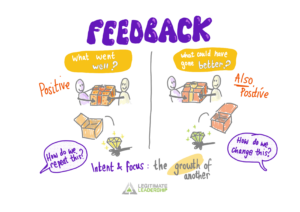
I don’t use the term positive and negative feedback anymore – when you get the intent right, all feedback is a gift. If we want to help others achieve their best, we need to give feedback that helps them to reinforce what went well and improve where things could be better. Surely, knowing about both of these areas is beneficial; as leaders, we should embrace every opportunity to provide such feedback.
Rachael Cowin, Associate, Legitimate Leadership.
________________________________________________________
Featured
Question Of The Month
How do I give feedback without demotivating my team?
When Coaching Alone Isn’t Enough: The Case for Systemic Change
I have been an executive coach since 2007. It is work I love deeply; there is something profoundly privileged about holding up a clear, unfiltered mirror for someone, creating the space for them to confront gaps in their own authenticity and leadership.
But over the past two decades, I have arrived at an uncomfortable truth: coaching, on its own, has limits.
When an organisation’s culture and systems are not conducive to a coaching or learning way of leading, even the most powerful individual breakthroughs can quietly unravel.
How To Give Feedback That Lands
In How to Give Feedback That Lands, Dr Renee St. Jacques challenges the common perception that feedback is something people naturally resist. Instead, she suggests that feedback becomes difficult when it feels personal, vague, or disconnected from growth. Effective feedback is not about judging someone’s character; it is about helping them understand the impact of their actions and supporting their development.

 Question Of The Month
By Tony Flannigan, Associate, Legitimate Leadership.
Question: How do I give feedback without demotivating my team?
Answer: Here’s the thing: the question itself contains a hidden assumption worth unpacking. Most people asking this are focused on the how of feedback. But whether feedback motivates or demotivates has far less to do with technique than most leaders think. It comes down to one word: intent.
Why are you giving this feedback? And, more importantly, does the person receiving it believe your answer to that question?
It Starts With Intent
Kim Scott, in her book Radical Candor, describes four kinds of feedback (a framework well worth exploring). But even the most skillfully delivered feedback will land badly if the person on the receiving end suspects it is coming from a place of judgement, frustration, or self-interest rather than genuine care for their development.
The Legitimate Leadership framework is clear on this: if your people believe you are giving feedback because you truly want them to be as good as they can be, that you are, in the deepest sense, for them, then feedback becomes a gift. If they don’t believe that, no amount of technique will save you.
So, before we talk about the ‘how’, get the why right.
The ‘How’ Still Matters
Once your intent is right, skill absolutely helps. Here is what works in practice:
- Give it promptly. The analogy with puppy training is apt; feedback three weeks after the event is largely useless. The closer to the observation, the better.
- Give it in manageable doses. Too much at once, and the key message gets lost. People switch off. Pick the one thing that matters most right now.
- Make it specific. “You were great in that meeting” tells someone nothing useful. Neither does “that didn’t go well.” What exactly happened? What was the impact? No data, no growth opportunity…
Read Tony Flannigan’s full response by clicking here.
To submit your question, email info@legitimateleadership.com
 Article: When Coaching Alone Isn’t Enough: The Case for Systemic Change
By Stefaan van den Heever, Associate, Legitimate Leadership.
This article was originally written by Stefaan van den Heever in 2018. Nearly a decade later, his observation that coaching alone cannot drive lasting change feels more relevant than ever.
I have been an executive coach since 2007. It is work I love deeply; there is something profoundly privileged about holding up a clear, unfiltered mirror for someone, creating the space for them to confront gaps in their own authenticity and leadership.
But over the past two decades, I have arrived at an uncomfortable truth: coaching, on its own, has limits.
When an organisation’s culture and systems are not conducive to a coaching or learning way of leading, even the most powerful individual breakthroughs can quietly unravel.
The Collision
Here is what I have observed, time and again. During coaching, a leader gains genuine insight. They commit to new behaviours. They leave sessions energised and resolved. And then, something happens. Their new frame of reference collides with the reality of the organisation around them.
A mission statement hangs on a wall. Values are printed in an annual report. But the lived culture tells a different story entirely.
I was part of an intervention at a manufacturing plant some years ago. The goal was to develop a coaching leadership style, one built on listening, asking questions, and genuine engagement. The training landed well. People connected to it. There was real energy in the room.
But when the pressure came, as it always does, people reverted. Command and control reasserted itself almost instinctively.
“It’s hard to collaborate with another department when we’re competing against them for KPIs.”
That sentence captures the problem precisely. You cannot coach people into a new way of being if the system they return to every day is designed to pull them in the opposite direction.
Read the full article by clicking here

Video: How To Give Feedback That Lands
By Dr. Renee St. Jacques is a psychologist, executive coach, and TEDx speaker who helps leaders build trust, strengthen relationships, and create high-performing workplace cultures through emotionally intelligent leadership.
Comment on the video by Leonie van Tonder, Associate, Legitimate Leadership: Ken Blanchard famously said, “Feedback is the breakfast of champions.” I couldn’t agree more. Actionable, continuous input is the essential fuel that individuals and teams need to improve, grow, and reach peak performance consistently.
But here is what I have learned from working with leaders, knowing this is not enough. How we give feedback matters just as much as whether we give it at all.
- Do not wait for annual performance reviews. Create structured, frequent opportunities for honest exchange.
- When you receive or give input, treat it objectively. Focus on the benefit of the proposed change rather than experiencing criticism as a personal failure.
- Keep your conversations separate, deal with “room for improvement” and “well done” in different discussions. Mixing the two dilutes both.
- Remember that as humans, we tend to remember what suits us, not necessarily what we need to hear. This is why frequency and structure matter.
- Do not put your solution on the table before the other person has had the opportunity to reflect and correct themselves. Give them that chance first.
- Awareness is half the battle. But real change only happens when new behaviour stops being something we have to think about, when it becomes part of who we are, not just learned or expected conduct.
Finally, be courageous. Do not be unkind, but do not soften your message so much that it loses its meaning. The person does not have to like the feedback in the moment. The benefit will show itself later.
Our summary of this video: In How to Give Feedback That Lands, Dr Renee St. Jacques challenges the common perception that feedback is something people naturally resist. Instead, she suggests that feedback becomes difficult when it feels personal, vague, or disconnected from growth. Effective feedback is not about judging someone’s character; it is about helping them understand the impact of their actions and supporting their development.
The video emphasises the importance of focusing on observable behaviours, being specific about the impact those behaviours have, and approaching conversations with a genuine desire to help rather than to criticise. When feedback is delivered with clarity, respect, and positive intent, it is far more likely to be received, understood, and acted upon.
From a Legitimate Leadership perspective, this aligns strongly with the principle of Care & Growth. Legitimate leaders recognise that growth cannot occur without feedback, and that withholding feedback to avoid discomfort may actually limit another person’s development. At the same time, feedback that is delivered without care can damage trust and reduce willingness.
The challenge for leaders is therefore to balance both dimensions: demonstrating genuine care for the individual while having the courage to address behaviours that may be holding them back.
Ultimately, the video reminds us that feedback is not a performance management tool; it is a growth tool. When leaders approach feedback as an investment in another person’s success, they create opportunities for learning, increased capability, and stronger relationships.
Our takeaway: Feedback lands best when people believe it is being given in their interest. The goal is not to be right, but to help others become better. That is the essence of coaching, growing others, and leading legitimately.
Watch the video by clicking here
