Articles
Leadership By Permission: Reflections From Our Latest London Open Programme
April 29, 2026 - By Sean Hagger, Managing Director (International), Lean Management & Leadership (Pharmaceuticals & Sustainability Tech)Share by Email
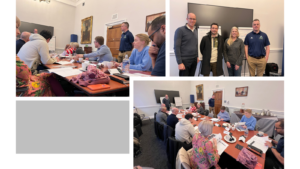 In February, alongside Ian Munro, I facilitated our latest two-day open programme on the Legitimate Leadership Framework in London. It brought together leaders from policing, the NHS, cyber security, chemicals, education and small business – a breadth of sectors and seniority that made the discussion both rich and refreshingly honest.
Despite their different contexts, the leadership challenges they described were similar. That is often the first breakthrough moment for participants: realising that the pressures they carry are not unique to their organisation or industry, but part of a broader human dynamic around authority and responsibility.
The 2 days were packed full of conversation and value for our participants.
Ian talked about the idea of the “accidental manager” – individuals who find themselves in leadership positions because someone left, someone was promoted, or someone had to step up. Too often, authority arrives without preparation.
“Legitimacy is not given because you have a sign on the door. It is granted by those who follow you.”
That single idea reshapes the way people see their role. Authority may be assigned, but legitimacy is earned. It is measured not by hierarchy, but by the degree to which people willingly support you.
We also challenged a deeply embedded assumption about performance.
“The product of excellent leadership is excellent people.”
Results matter, but they are not the primary output. When you focus on developing excellent people – capable, confident, values-driven individuals – performance follows. And sometimes, excellence means someone you have developed is ready to move on. That, too, can be evidence of leadership done well.
Throughout the two days, I returned to the idea of “power by permission.”
“You don’t know if you have legitimacy until you turn your back.”
It is easy to feel secure in your leadership when conversations are positive around you. The true test is what happens when you leave the room. Every interaction communicates intent. Every email, every meeting, every corridor exchange contributes to a pattern people are constantly interpreting.
This is where the “intent test” becomes critical.
“Suspend your agenda for theirs.”
In practical terms, that means quietening the internal voice that is waiting to speak and instead listening with genuine care. Not to acquiesce, but to understand. When people feel ignored, trust erodes quickly. When they feel heard, legitimacy strengthens.
I also spent time on behavioural standards – because culture change is not achieved through slogans or strategy decks.
“You cannot play a good game on bad behaviour.”
If punctuality matters, leaders must model it. If preparation matters, it must be consistent. Behavioural standards are common; they apply equally to the CEO and to someone on site for twenty minutes. When behaviours stabilise, performance has something solid to build upon.
Ian reinforced the incremental nature of leadership growth:
“You don’t have to get it right. You have to get it a little more right than yesterday.”
Maturity in leadership is not about accumulation. It is about developing the capacity to give.
What Participants Experienced
One of the most encouraging aspects of this programme was not simply the content, but the environment that formed over the two days.
Nigel Dawe, observing as part of the Legitimate Leadership team, captured it perfectly:
“I think we’ve got a great group here. In fact, they almost built themselves into a team. The interaction has been fantastic.”
He also reflected on the nature of the learning:
“This is not a training course per se. This is all about raising awareness of what leadership fundamentally is… It’s about working through it together.”
That sense of shared exploration was echoed strongly by participants.
Andy Gilbert – one of our participants – described the experience as:
“Being given the opportunity to spend two days revisiting sensible academic content that can be translated into some really worthwhile outcomes.”
Troy Simpson spoke about the value of stepping away from a really busy job:
“My job is very much go, go, go… So to come out for two days… gives me that opportunity to really be reflective and think about who I want to be and how I want to show up.”
He also shared something many leaders quietly experience:
“When you get into leadership positions… it can be quite an isolated environment… Listening to the challenges that other people are having… You understand that it’s not only you.”
And Serafine O’Brien spoke about what progress in leadership really is:
“Across both days, we’ve talked about how it [progress] is incremental, and that’s okay. And some days it will maybe slip back a bit and go forward. But we’re human, and that’s the whole point of the course.”
Across the two days, it was great to see participants peer-coaching one another, challenging assumptions, and sharing lived examples from their own sectors.
The overnight pause had allowed ideas to settle and deepen. You could see the lightbulb moments – not dramatic revelations, but thoughtful recalibrations about how each person wanted to lead when they returned to work.
For Ian and me, it was energising. Not because of the positive feedback, but because of the quality of the conversations and the seriousness with which people engaged the material.
We will be running further open programmes throughout the year. If you are interested in developing leadership grounded in legitimacy, behavioural integrity and genuine intent, please get in touch, and I will ensure you are added to the waitlist for upcoming dates.
Leadership by permission is not a technique. It is a discipline. And when practised consistently, it changes organisations from the inside out.