Articles
Podcast: Lead From The Heart – Preparing For The Launch In China Of The Legitimate Leadership In Action Book
November 27, 2024 - By Simon Zhou, Global Chief Gathering Officer, Gathering ConsultingShare by Email
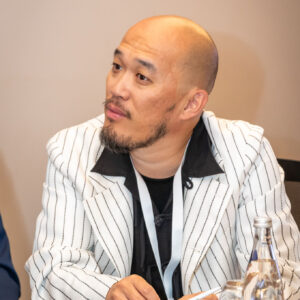
Ahead of the launch in China of the Mandarin version of the book Legitimate Leadership In Action, Simon Zhou, Legitimate Leadership’s representative in China, visited Wendy Lambourne in Cape Town, South Africa, and recorded a podcast with her (link below).
In the podcast, Wendy Lambourne, the book’s author, said that Legitimate Leadership is essentially a framework for understanding what accounts for trust in the leadership of an enterprise, no matter what its size.
Wendy Lambourne: “Our research has found that people’s trust in management is not based on things like how much they are paid or what facilities they are given. It is based on something much more personal – essentially, the relationship that any individual in an organisation has with their immediate manager. Depending on what that relationship is like, it generalises. So if your relationship with your manager is positive, you will have an overall more positive view of leadership in the organisation. If it is negative, that becomes your view of the leadership in the organisation.
“And what makes this relationship positive or negative boils down to intent: whether the leader’s intent is to give to you or to get from you.”
“Regarding legitimacy, if you are in a leadership position in an organisation, you have the authority which comes with the position. But in our view you only have real power when you deliver on two things: you genuinely care about the people you have authority over AND you enable them to become the best they can be.”
“This is not philanthropy because we know that sustainable results can be achieved with exceptional people. So the leadership job is not to get results out of people but to cultivate excellence in people and then the results will naturally follow.”
Simon Zhou: “We first met when you visited China in 2014; you visited us again in 2017.”
Wendy Lambourne: “We initially exposed the framework to people working for a UK business which operates in China. You also exposed it to people by running a workshop in Mandarin. I was struck by the response of Chinese managers, who said that this approach was different and fresh. The framework resonated with people in China as it has resonated throughout the world. The reason is the idea that you stand or fall based on your intent or motive.”
Simon Zhou: “It’s about redefining leadership as being less about hierarchy and more about relationships. But how do we do this redefinition, and how do we challenge the conventional wisdom?”
Wendy Lambourne: “Generally with managers, if you ask them what they are here to do, they reply that they are here to get results out of people. As a result everyone ends up seeing people as a means to an end. The end is the result. When you see people as a means to an end, you only have two instruments to motivate them: the stick (force) or the carrot (incentives or bribes). But these two instruments get movement, not willingness. Willingness means even when you are not there, they still want to go above and beyond in service to the customer. Our experience is that this happens when leaders deliver care and growth. Deliver those two things and people will follow you to the ends of the earth.”
“A bank in Savannah, Georgia, USA, was very successful. Consultants asked the chief executive why this was. The executive replied that it was ‘love’. When the consultants asked others in the bank the same question, they reiterated that it was ‘love’. Then the consultants asked the chief executive, ‘But we see all over the place the message 100/0 … what does that mean?’ The chief executive replied, ‘It means 100% responsibility, no excuses.’ ‘But what does that have to do with love?’ the consultants asked. ‘It is tough love, we not only care, but we also hold them accountable,” was the reply.
“Once you get the care and growth philosophy embedded in your business, you produce mature people. Mature people are givers, not takers. And when you have enough people in your organisation with the intent to give, not to take, you get exceptional organisational results.”
“Giving has two forms:
- Generosity – if someone needs something (money, praise, recognition, support, mentorship, etc), these are given.
- Courage, which is far less frequently encountered in managers – this is not putting THINGS on the line, but putting SELF on the line. Courageous leaders stop controlling people and hand over decision-making. They have honest conversations and hold people accountable. They have the courage to give, for instance, differential bonuses.”
“I have been working with this framework for 30 years. It started in a commercial explosives factory in South Africa. By installing this framework we dramatically increased our safety performance at the factory. Using the framework, we did not set out to change our people, we changed ourselves as leaders first.”
“I was completely convinced by the framework. So, over the past 30 years we have developed it. We have found out what is required of leaders to become legitimate day-to-day. The same principles apply throughout the world.”
Simon Zhou: “So this could be a common language of leadership for our Chinese chief executives to apply throughout the world …?”
Wendy Lambourne: “Yes, it’s a shared leadership language. I would say to Chinese leaders: lead from the heart. Be there for your people, as opposed to your people being a means to your end.”
Simon Zhou: “Most importantly, we need to focus on the why. Traditionally we focus on the what and the how.”
TO LISTEN TO THE PODCAST CLICK HERE