Videos
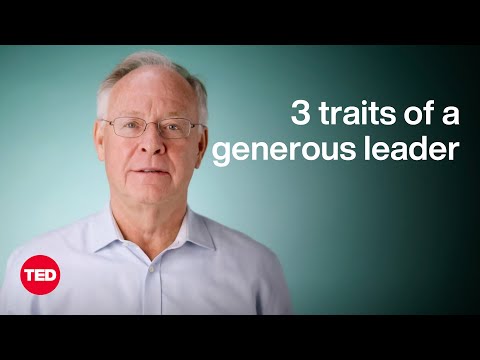
Is Generosity The Most Underrated Leadership Skill?
May 28, 2025 - By Joe Davis, former regional chair for Boston Consulting Group in North America, and author of the book The Generous Leader: 7 Ways to Give of Yourself for Everyone’s Gain.Share by Email
COMMENT ON THIS VIDEO EXCERPT BY WENDY LAMBOURNE OF LEGITIMATE LEADERSHIP
Giving is only giving if it is unconditional – giving without expectation of getting. Joe Davis provides some good examples of generous giving. But to be an exceptional leader requires two forms of giving, not one. The other form of giving is courage – it is about putting oneself on the line. Of the two, courage is more difficult because the price that may have to be paid is greater. What we need are leaders who are both generous and courageous.
OUR SUMMARY OF THIS VIDEO: My first job was as a sales rep for Procter & Gamble; thereafter as a manager with three reps reporting to me. They were in their 40s I was 26 and frankly I had no idea how to be a manager. I rode with them every two weeks, visiting stores yet rarely giving any feedback. I was in awe.
Then it came time for year-end reviews. I compiled a list of things that each person could do to improve. I launched into my review with Rich. About three minutes in he cut me off: ‘Wait a minute, you ride with me every two weeks and you’ve never said any of these things!’ I was mortified – he taught me something in that moment.
Leadership isn’t about role or position, it’s about generosity. We need generous leaders, who give of themselves freely without expectation of personal gain so others can develop, grow and thrive at their full potential.
Since Procter & Gamble I have had multiple roles at the Boston Consulting Group, overseeing teams of three people to 7,000. I have also had the privilege of interviewing many executives across many industries for my book on generous leadership, and let me tell you: what a leader is, and what is demand of them, have changed.
We now need to bring our human selves to work and they expect to see humanity in their leaders.
Let me be very clear: being generous is not simply about being nice. As Joaquin Duato, CEO of Johnson & Johnson, put it very plainly: outcomes do matter, a leader must get results.
But the sooner they can look past themselves and connect more deeply and personally with their people and help unlock all the essential human traits of their team, the sooner they will drive to those results.
So start being a generous leader! There are seven traits of a generous leader, but today here are three tips:
- Be curious and listen generously. No doubt you’ve heard this advice before and maybe you consider yourself a good listener. But let me ask you this: to whom are you listening – the senior team, your own leadership team? How about your direct reports’ direct reports’ direct report. Have you asked your assistant for their insights? Generous listeners ignore the traditional barriers of titles and hierarchy. They ask and listen, they listen to learn, and with that respect they inspire others. Take Scott Kirby, CEO of United Airlines. Anytime someone’s getting promoted to a vice president position in United Airlines he schedules a one-on-one interview with them. Can you imagine how rare that is? When I interviewed Scott for my book he recalled sitting down with three candidates for vice president of operations. Each started as a technician, the person out on the tarmac doing maintenance every day to keep passenger safe and the planes on time. It is a critical function, but many, many layers away from the CEO. But Scott was still curious enough to ask them: ‘What do technicians need most?’ And each of those candidates said the same thing: ‘Sir, we don’t have enough spare parts on-site.’ Scott said that was such an epiphany for him – the technicians on the front line of course want to do well, but when they don’t have the spare parts on hand they can’t do their job with pride. So though Scott knew the financial people would not be pleased, he increased parts at the airports as he believed supporting the pride of the technicians would pay bigger dividends. Asking and listening helps you better solve tough challenges, but crucially it shows respect, it tells the person you see them as a human with valuable insights
- Be vulnerable, put down the mask. Easier said than done, I fear. When I was a young leader I felt so much pressure to have all the answers. It never occurred to me to be vulnerable; I’m not even sure I knew what the word meant. Even today many wonder what it means. An example: I was talking with a colleague about his own vulnerabilities. He said that if he sensed his team was getting lost and they might ask him what to do and he also didn’t know what to do he would literally get up and leave the room rather than say ‘I don’t know.’ Real productive huh? Finally, one day he thought, ‘This is silly.’ He stayed in the room and admitted, ‘I don’t know either.’ He was astonished to what happened next: the room erupted with energy and ideas. Since the boss didn’t know it was okay for everyone to move past their fear, their roadblocks, acknowledge their own vulnerability and get to work to figure it out.
- Be generous in the moment, in every moment, especially when there’s nothing for you to gain. That’s the true definition of generosity. I was talking to a leader and one of the most prestigious firms in the world. He recalled sitting in a gorgeous conference room with a view of the city that doesn’t quit, with nine other leaders deciding the fate of today’s young interviewees. First candidate: great interview scores, super grades, solid resume, she’s in! Number two: average across the board, that’s a no! Number three: knocked it out of the park on the interviews, we don’t see this very often, but another person spoke up: ‘He has a mid-2.0 college GPA (grade point average), we know people with that grade range just don’t last.’ The conversation went back-and-forth, got a bit heated, but the mood swung to a ‘no.’ Then my friend who had been sitting silently, spoke: ‘I have to tell you all something I’ve never told anyone before: I had those grades at college. What can I say, I wasn’t focused. But I got my act together, got in the business school, got hired here, was made senior partner, and now I’m the head of this office. What do you say we give this young man a chance too?’ This is a lovely story. But here’s why it’s interesting: it didn’t matter whatsoever to this executive if that young man was hired. There were plenty of other candidates, so why would you make this vulnerable admission to save a mere stranger? Because that’s what it means to be generous in the moment. It is to take each and every opportunity you get to help others grow and thrive at their full potential – even when you personally have nothing to gain. Generosity is what will move you from the good manager category to an exceptional leader. Your people are not only motivated by your dazzling strategies, your brilliant plans, your inspiring targets and metrics. When they see you bring your full heart into your leadership and share your humanity, that is when they will follow you anywhere.